Genset Digest / Industrial Blowers & Process Air / Stelmor blower
Stelmor Blower
The blowers under a wire rod cooling conveyor are the instrument that controls the metallurgy of the finished coil. This page covers what the duty asks for, why the rings are cooled unevenly by an evenly distributed airflow, and what quietly changes the distribution after commissioning.
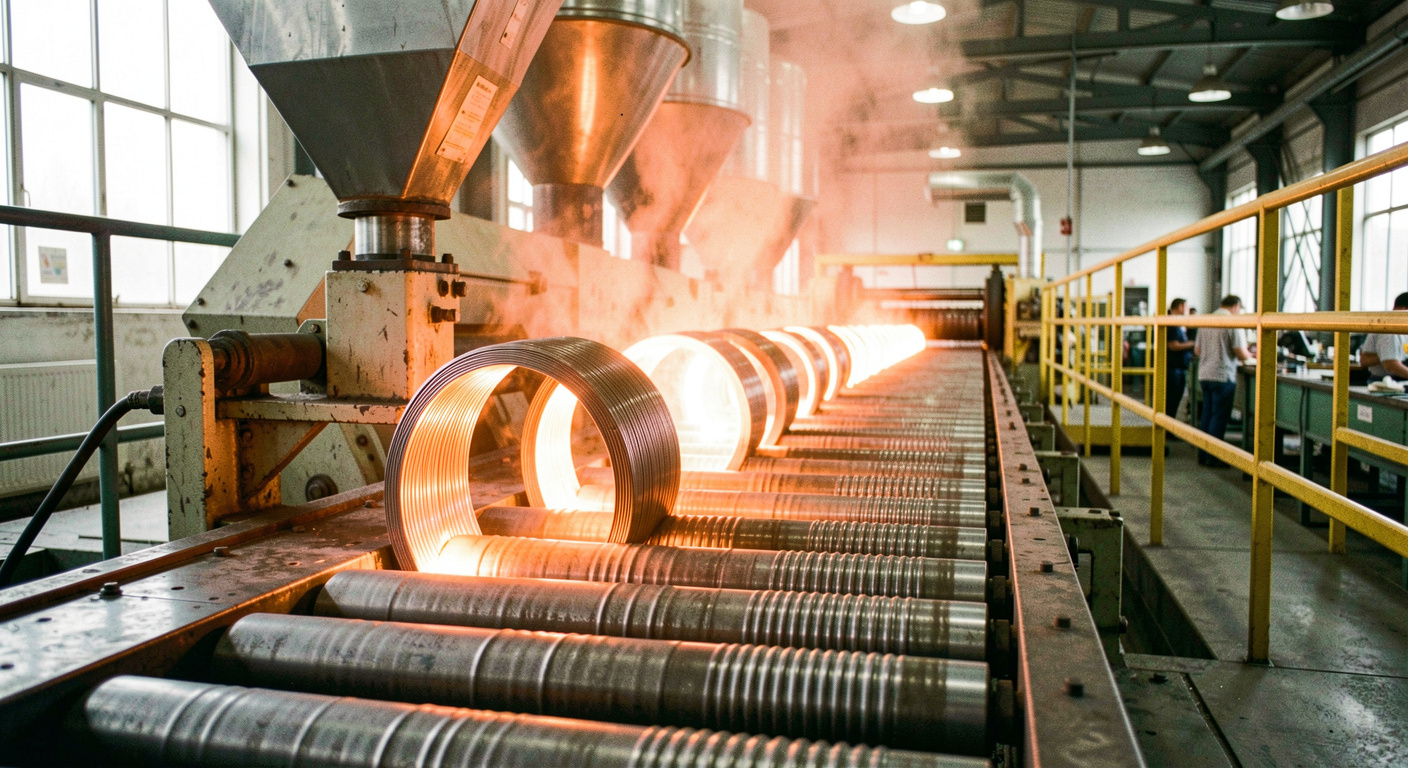
A Stelmor line is a controlled cooling conveyor for hot-rolled wire rod, and the blowers under it are the instrument that does the controlling. Rod leaves the laying head at a temperature typically between 750 and 950 degrees Celsius, is laid in overlapping non-concentric rings onto a moving roller conveyor, and is cooled from below by air forced up through the conveyor bed. The name comes from the process developed by Morgan Construction, and the principle has not changed: what changed is the precision expected of the air.
The point of the exercise is metallurgical. Controlled cooling at rates in the range of 2 to 20 degrees Celsius per second produces a fine pearlitic structure directly on the line, which is what allows a rod to go to the drawing shop without a separate off-line heat treatment. Cool too slowly and the structure coarsens; cool unevenly and the same coil has different properties at different points along its length.
Why uniformity matters more than volume
Rings laid on a conveyor are not evenly distributed across its width. Where the rings overlap, near the edges of the conveyor, there is more steel per square metre than at the centre, and therefore more heat to remove. Air delivered evenly across the width will overcool the centre and undercool the edges, which is exactly the wrong result.
The blower system is therefore built as a series of zones along the conveyor, each with its own fan, its own plenum and its own damper or drive control, and the plenum itself is profiled so that the air distribution across the width matches the steel distribution. Getting that profile right is the difference between a line that produces consistent tensile properties and one that produces a metallurgist's argument twice a week.
| Parameter | Typical range | Effect if wrong |
|---|---|---|
| Laying temperature | 750 to 950 degrees C | Sets the whole cooling curve |
| Cooling rate | 2 to 20 degrees C per second | Structure too coarse or too hard |
| Conveyor speed | 0.2 to 1.5 m/s | Changes ring density and dwell time |
| Fan volume per zone | 1,500 to 4,000 m3/min | Rate cannot be reached |
| Static pressure | 1.0 to 2.5 kPa | Poor penetration through the ring bed |
| Rod diameter served | 5.5 to 25 mm | Larger rod needs longer dwell |
The machines themselves
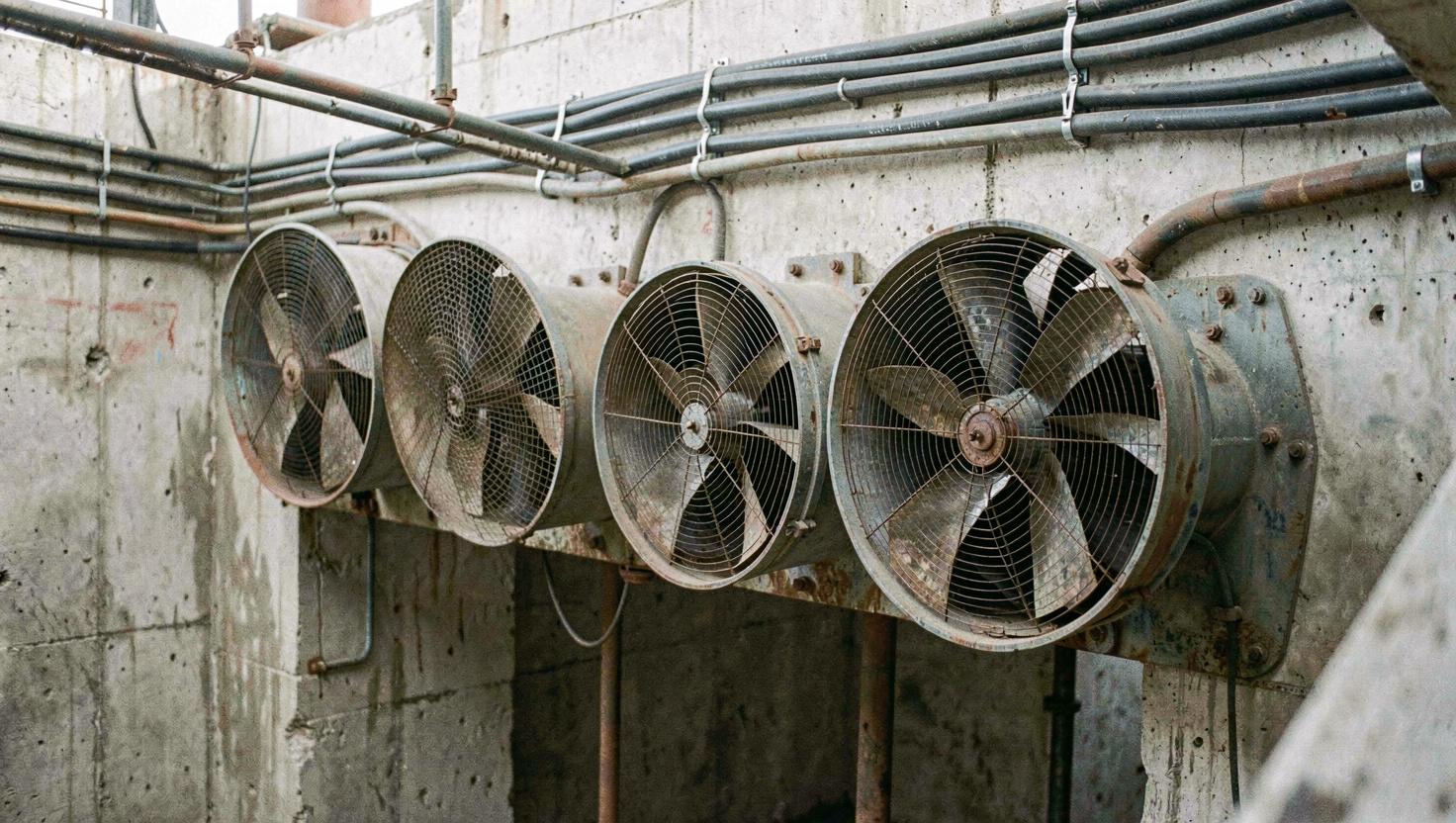
Stelmor duty is high volume at low pressure, which points to axial fans rather than centrifugal ones. A typical zone fan absorbs somewhere between 55 and 160 kilowatts and delivers a few thousand cubic metres per minute at one to two and a half kilopascals of static pressure. A full line may carry ten to fourteen such fans over its length, sequenced so that the early zones do the heavy work and the later zones trim.
Because the fans are large and numerous, the fan house is often the largest electrical load in the mill after the main drives, which is why it appears in the plant's standby power calculation and why the sizing method for generating sets is a relevant companion page for anyone specifying backup for a rolling mill.
Airflow distribution across the conveyor width should be verified with a traverse at commissioning and re-checked after any plenum modification. A blocked section of grating, a dislodged baffle or a damper stuck at 60 per cent will not raise an alarm anywhere. It will show up weeks later as scattered tensile results from one part of the coil.
What goes wrong in service
Three problems dominate. Scale and mill debris accumulate in the plenum and on the conveyor grating, progressively changing the distribution that was so carefully set at commissioning. Damper linkages seize, so a zone that is supposed to modulate sits at a fixed position. And belt drives on the older fans slip, which reduces volume gradually enough that nobody notices until the product changes.
None of these announce themselves. All three are found by the same discipline: periodic measurement of the actual air distribution rather than of the fan's electrical current. The same principle applies to every machine in the industrial blower section, and it is closely related to the wear-driven maintenance regime described for dedusting blowers in sintering and blast furnace plants.
How it differs from the other duties in this section
A Stelmor blower moves clean ambient air at low pressure through a bed of hot steel. A dedusting blower moves dirty gas at high resistance through a filter. A combustion blower moves clean air at high pressure into a burner against a fuel-linked control loop. The three are not interchangeable, and specifying one from the data sheet of another is a mistake that is usually discovered at commissioning. The pressure duty case is set out in the combustion blower page.
Where a cooling duty has to be retrofitted onto an existing line, the constraints multiply: the new machine has to fit the old plenum, hold the old noise limit and match the old duty point. That is the shape of the brief examined in the sintering machine loop cooling blower profile.
Read next
For the opposite duty, high resistance and abrasive gas, read the dedusting blower page.
For a worked retrofit brief with noise and duty cycle constraints, the sintering machine cooling blower profile is the closest case in this magazine.
A mill fan house is a large electrical load. If backup power is being specified around it, the generator sizing method shows how that load becomes a kVA figure, and the blower section index collects the rest of the process air pages.